

Body Image and Fatphobia in the Bedroom
TLDR: Internalized anti-fat bias (and not bodies themselves) can harm your sex life by making you feel unattractive, unsafe, or distracted during intimacy; this bias towards fatness shows up whether it’s directed at yourself, your partner, or both, and can erode emotional safety, trust, and pleasure. Unlearning fatphobia and cultivating a more compassionate view of bodies can improve body image and sexual connection.
As a therapist specializing in trauma, body image, and sex therapy for women, I always make it a point to ask women how they feel about their sex lives. Sex is an important part of our humanity after all! For most women, negative feelings about their bodies is a barrier to having a happy, healthy sex life, both generally and during times of great bodily change like pregnancy, postpartum, and perimenopause.
But when we scratch under the surface, it quickly becomes apparent that what is actually getting in the way is not your body, but the negative attitudes our culture has toward fatness that we internalize. Simply put, if you have negative attitudes and feelings towards bodies - your own or your partner’s or both - it is going to negatively impact your sex life.
Also, a quick note - I use the term fat as a neutral descriptor, similar to tall or short.
What is fatphobia?
Fatphobia literally means fear of fatness, and while many people do fear fatness, this term doesn’t quite capture the harm of negative attitudes about bodies and fatness. The terms antifat bias and antifatness are more broad and do capture this harm, but many people still use the term fatphobia. Antifat bias includes the negative attitudes, behaviors, and systems that pathologize (i.e. treat as disease), marginalize, exclude, underserve, and oppress fat bodies. It is our cultural belief that thin bodies are healthier, better, and more attractive and that fat bodies are unhealthy, unattractive, and less than.
This is the air we all breathe - we are indoctrinated into this harmful and overly simplistic way of thinking about bodies before we can even consent to it.
When this is the way we have been taught to think about bodies, and when we see how larger bodies are treated, it starts to make sense why people fear fatness. But what is really feared is experiencing antifat bias - being viewed as lazy, unattractive, not having accessible clothing options, being judged as unhealthy based on size alone, etc.. Everyone in all body sizes is harmed by antifat bias with the harm existing on a spectrum, increasing with the size of the body. But how does this show up in the bedroom?
Fatphobia vs Body Image
I talk a lot about body image, because that is the language clients are using to discuss the distress they feel about their bodies. It’s in the title of this blog even! (Because I want to reach people that aren’t searching using terms like fatphobia).
And that is an accurate term.
But, it misses the bigger picture - we didn’t learn to feel negatively about bodies in a vacuum. Nobody is born hating their body. Instead, we are taught to feel this way by a systemic view meant to oppress. Referring to the problem solely as a body image problem, incorrectly places the blame and onus on the individual, when it is nobody’s fault they feel this way about bodies! This is a societal problem and to only label it as body image unfairly blames women and hides the systemic nature of the issue.
What are The Origins of Antifatness?
Thinness has only been the preferred body type in the US since the early 19th century (which PS is 100 years before the medical system started being concerned about fatness, evidence that negative views about fat bodies were never about health). The reason thin bodies started to be preferred is because of a collsion between racism related to the Trans-Atlantic slave trade and Protestantism. Skin color became a less useful way to sort people in a hierarchical way after interracial sex and sexual violence blended skin tones. Racism meant that Black people were viewed as prone to “excess” and had inherently voracious appetites. Protestantism advocated for total restraint in all pleasurable pursuits, especially food and sex (this was the era of Steven Kellogg and Sylvester Graham of corn flake and graham cracker fame advocating for eating bland foods as a way to suppress sexual urges). The intersection of these beliefs meant that appetite for food and sex was viewed negatively and Black people were viewed as having uncontrollable appetites for both. Despite fat and thin bodies existing in all groups of people, fatness became a marker for these “undesirable” traits in Black people and a way to separate and oppress Black bodies. White women in particular were encouraged to remain thin to be Christian and demonstrate racial superiority (and of course over time, antifatness became internalized by all groups). For more information on this super important topic, please check out Dr. Sabrina Strings’ book “Fearing the Black Body: The Racial Origins of Fatphobia.”
So given that anti-fat bias is the air we all breathe, how does this show up in the bedroom?
What happens if you are viewing yourself with anti-fat bias? You may…

Feel undesirable and unattractive, and assume your partner (or potential partner) feels the same way. After all, if it feels like a fact that your body is unattractive, it won’t feel like a possibility that someone else may view you differently.
Have a hard time receiving expressions of someone else’s desire, because of the stories you are telling yourself about them not really being attracted to you, losing their attraction or feeling disgust if they fully see your body, or that their desire is charitable or pity sex somehow
Hide your body, with low light or darkness, clothing, or bedding
Avoid certain sexual positions, activities, or angles because of how you fear you will be perceived
Have difficulty believing your partner when they say they find you attractive
Avoid sex or dating all together or put it on hold until you’ve lost weight
Have an incredibly hard time feeling present to your body sensations or the connection by your partner because you are so distracted by your own negative body thoughts and how your partner is perceiving your body
Experience shame, fear, or embarrassment about your partner supporting your body weight, breathing heavy, or sweating during sexual activity
Assume that if your partner isn’t interested in sex or can’t maintain arousal or reach an orgasm that it is because of your body
These experiences are incredibly painful and vulnerable. It is also possible that all partners might be feeling this way (again, this is the air we all breathe!). Again, I want to point out, in each of these scenarios it’s not the actual body that is the problem, it is the way we have been taught to think and feel about bodies. All bodies are capable of positive sex lives and many partners either don’t care about body size or composition, or prefer a larger body type. However…
If your partner is viewing you with antifat bias…
You might fear rejection and criticism, or there may be outright or subtle criticism or emotional abuse
Your own antifat bias is reinforced, making your body shame and negative body thoughts more intense
You might be motivated to engage in disordered eating or exercise behaviors, feeling like you have to fix your body
Sex (and probably the whole relationship) is no longer emotionally safe. And if it’s not emotionally safe, then you can’t fully be vulnerable, which is required for a satisfying sexual or emotional connection.
What should be a safe harbor (your intimate relationship) from dehumanization, shaming, and oppression, becomes a source of it
It becomes much harder to improve the way you feel about your own body
This is a really challenging situation to navigate. If you had a relatively strong body image before, having a fatphobic partner might just piss you off, but it can also erode your trust and positive feelings about your body. Either way, it most definitely undermines and harms your sexual and emotional relationship. In the worst case, this situation can escalate to emotional abuse or trigger/exacerbate disordered eating or exercise.
And if you are viewing your partner with antifat bias (again - it is the air we all breathe), you might…
Feel shame and guilt about having these thoughts about the person you love
Worry about them catching on to your feelings and hurting them
Try to overcompensate for these feelings, resulting in praise and reassurance that doesn’t feel genuine
Start to police your partner’s body, food, and movement choices
Blame sexual or relationship problems on your partner’s body rather than antifat bias or other underlying relationship problems
Fear becoming fat or fatter yourself
Criticize your partner or completely avoid the topic of bodies, sex, or attractiveness
This is also a hard situation and for the person on the receiving end, it can be downright traumatic. I find that either people feel a great deal of guilt and shame about how they feel about bodies, because it is at odds with their values, love for their partner, and they know it’s wrong OR they are stuck in the paradigm of thinking that the body is the problem, and not their attitudes or behaviors, and can’t see the problem or worse, think they are “helping.” Either way, the relationship cannot heal until and unless you are willing to bravely look at how your own antifat bias is harming your partner, your relationship, and yourself. Emotionally healthy relationships are not possible until this work is done. It is hard work, but it is not only possible, it is extremely rewarding and liberating, much like any other anti-oppression work.
It is important to note that people experience these three situations in any and all possible combinations. It is also possible for each partner to be viewing themselves and each other with antifat bias, such that all three sections above might apply to each person.
How Can I Improve Body Image During Sex?
If this resonated with you, know that it does not have to be this way, even if at present you cannot even imagine what it would look like to think and feel differently about bodies. It may feel like a fact that larger bodies are bad and thin bodies are good, but this is what we are taught, not what is real or values-aligned. Just as we learned this, we can unlearn it and learn to take a broader, more compassionate, and complex view of attractiveness. For anyone wanting help in these areas, working with a weight-inclusive sex therapist can really be so helpful. I absolutely love to help clients with this.
I also wrote about my favorite resources (podcasts, books, etc.) to help unlearn antifatness and improve body image.
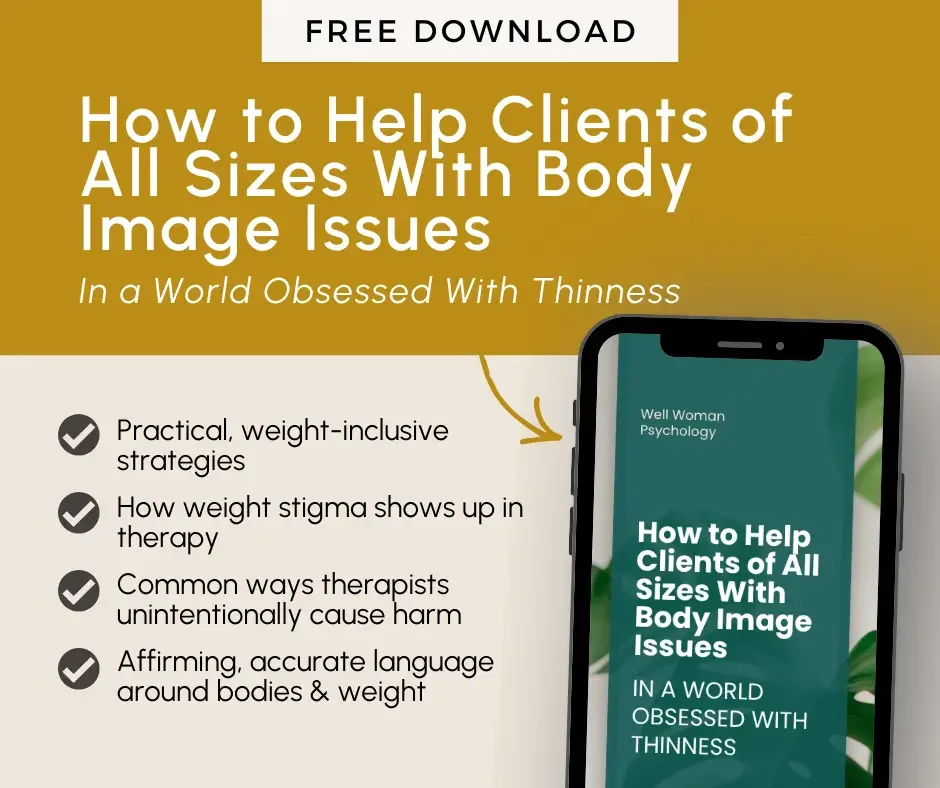
Complimentary Guide for Therapists
If you’re a mental health professional and you have clients who struggle with body image issues and/or clients in bigger bodies, then this guide is for you. Learn how to make your practice size inclusive with practical strategies, resources, research and data, case studies, plus much more!
Start Therapy for Body Image and Sex in Los Angeles:
It’s incredibly hard to feel good about your body in a culture that tells you your body is simultaneously too much and not enough. And if you don’t feel good about your body, it’s going to be near impossible to have a satisfying and emotionally healthy sex life. Reclaim sexual pleasure and build a kind relationship with your body by following these steps:
Reach out for a consultation at Well Woman Psychology.
Meet with a therapist specializing in weight-inclusivesex therapy
Conquer fatphobia and replace it with self-compassion and liberation.
About the Author:
Dr. Linda Baggett is the Licensed Psychologist and owner behind Well Woman Psychology, a boutique therapy practice serving clients virtually in California, Colorado, Illinois, New York, and Washington. Dr. Baggett has worked at the intersection of body image and sex for years (including her dissertation) and loves helping women build healthier relationships with themselves, raise the bar on partners, and reclaim pleasure and joy. She is trained in many evidence-based trauma treatments, including EMDR and sex therapy. She also works with clients to heal from trauma, relationship issues, pregnancy loss and miscarriage, infertility, perinatal and postpartum struggles, perimenopause and menopause, body image and size-based oppression.
Disclaimer: This blog is for educational and informational purposes only, is not a substitute for individual medical or mental health advice, and does not constitute a client-therapist relationship.