

12 Ways Therapy Can Help Perimenopause
TLDR: Therapy can help you navigate perimenopause in many ways, including helping you find good healthcare providers, improve sleep and coping skills, build a healthier relationship with your body, cope with anxiety and aging, and grieve the loss of reproductive years while exploring what’s next and much more!
If perimenopause is a natural, physical change that happens to the body, can therapy help?
YES IT CAN! I’m so glad you asked. 🙂
Therapy is a powerful evidence based intervention in and of itself, and is hugely helpful for any major life transition. Of course, the most important factor in determining how helpful therapy is, is the degree of fit between you and your therapist. This is why it’s so important to choose someone you feel has the expertise you are looking for and with whom you feel safe and comfortable. If you want more pointers on how to find a good therapist, check out my guide on exactly that.
But, back to perimenopause.
Therapy can specifically and absolutely help women and people with ovaries cope with the huge life transition that is perimenopause/menopause. Keep reading to learn how it can help, but if you could benefit from more general information about perimenopause first, be sure to check out my Ultimate Guide to Perimenopause for an overview on everything you need to know.
How can therapy help me cope with perimenopause?
Find a good perimenopause provider:
Finding a competent doctor who knows how to treat perimenopause and takes you seriously can be hard to find, even among OB/GYNs. Learn how to look for and vet healthcare providers, as well as tools to feel empowered to advocate for yourself, set boundaries where needed, and cope with gender/racial/anti-fat/etc bias in the medical system.

Improve sleep:
How we talk to ourselves (think) and what we do (behavior) can help or hurt sleep at any stage of life, and this is true in perimenopause too. If anything, it’s extra important to make sure you are setting yourself up for the best sleep you can get. Cognitive-behavioral therapy and mindfulness-based interventions are helpful at improving sleep quality during perimenopause.
Develop coping skills:
The key to managing any challenge in life, is a strong foundation of coping skills and that includes perimenopause. While therapy can’t make symptoms like hot flashes or itchy ears go away, it can help you cope with them more effectively so that they aren’t as distressing and don’t throw off your balance so much. For instance, hot flashes are bad enough on their own, but if you find yourself dreading them, getting upset when they happen, and spending a lot of time trying to prevent them, they can take over your life. How you are talking to yourself about bothersome symptoms, and what you are doing to manage, can either make things much better or much worse. Therapy can help you develop effective tools to cope so that they take up as little space as possible for your life and you can direct your energy elsewhere.
Use perimenopause rage as a gift:
If you are feeling extremely irritable, the intensity of it may be hormonal, but whatever you are upset about is valid and anger is our body’s way of telling us something needs to change. Maybe it’s that people-pleasing is no longer working for you, that you are overdue in addressing past trauma, that you need to do less emotional labor for others, need more time for yourself, or something else. Therapy can help you develop tools to keep the intensity of anger in check and learn to listen to what it is telling you, so that it doesn’t harm your relationships and you can channel it into appropriate action to make your life better.

Improve your relationships:
People joke about “meno-divorce” and it is true that many people complain of relationship strain during perimenopause. I find that this typically shows up in one of two ways. Your perfectly sweet loved one isn’t doing anything wrong, but you can barely stand to hear them breathe because of the hormonal impacts to mood and anger OR you were ignoring or minimizing many small (or maybe even big) problems in these relationships that you can no longer ignore because you have less bandwidth. Either way, our feelings exist to communicate information to us about our unmet needs and there is great value in learning to tune into them, figure out what they are trying to tell you, and make a plan to address those unmet needs, whether that’s taking more time for yourself, setting boundaries, letting go of people pleasing, or something else.
Stay steady in the face of mood swings:
Mood swings can feel very destabilizing and disruptive. Hormonal shifts can shorten your emotional fuse so to speak, making it more likely to experience emotions more intensely. However, perimenopause presents a real opportunity to slow down and learn to take care of yourself to extend that fuse and live more peacefully. Therapy can help you learn strategies to both tune into what your emotions are telling you about what you need (and act on that), and cope with them so that they aren’t taking over.
Improve your relationship with your body:
We have all known a 70+ woman still obsessing over calories, feeling guilt and anxiety about food and movement, and nitpicking their bodies. I grieve (but do not judge) for these women, and… it does not have to be this way (and if you are this 70+ woman, it’s not too late to change your relationship with your body!). Therapy can help you change that way you think about bodies by slowly unlearning what we have all been taught. It can also help you let go of stressing about food and exercise and enjoy food and movement instead, building sustainable self-care habits to last the rest of your lifetime. And it can help you learn to build a peaceful, supportive relationship with your body and let go of ageist and ableist and fatphobic ideals (the air we all breathe) about what makes bodies worthy or not. Body liberation is hard fought, but wonderful and freeing.
Improve your health:

“But what about health!” Most of what impacts our health is beyond our control (genetics, aging, environment, social determinants of health), AND, having a health challenge does not make you less than. That being said, for clients who do have a health concern they want to work on, therapy can help support this goal. Research shows that health behaviors such as consuming fruits/vegetables, getting exercise, sleeping adequately, avoiding drugs/alcohol/nicotine, and managing stress, improve health in significant ways, regardless of weight. Read that again - you do not have to try to lose weight to improve your health.
I mentioned in the point above that therapy can help you build sustainable self-care habits to last a lifetime. What I mean by this is that the best way you can achieve these health behaviors is by making them a habit, and the best way to make them a habit is to make them realistic, accessible for you and your life, and enjoyable or at least not painful. When you force yourself to eat and move as you think you “should,” you are likely to burnout and drop the habit. And how “healthy” is it to be stressing out about these things? But if you make an individual plan to problem solve the barriers to these behaviors (like shame, holding yourself to the standards of your youth, perfectionism, too many demands on your time, or wanting to rebel just to name a few) and and find ways to do them that feel GOOD and are aligned with your values, preferences, and identities, you are much more likely to have these behaviors turn into habits.
Cope with anxiety and aging:
Therapy can help you learn to manage your anxiety so that you’re in the driver seat, rather than the anxiety. It can also help you make sense of all the changes you are experiencing and manage any stress about health or mobility problems that can crop up with aging and the decrease in estrogen. You will be able to face these concerns in an empowered, grounded, effective way rather than in a state of panic.
Get support and feel less alone:
Going through something difficult is much worse when you feel like you are going it alone, lack support, or don’t have a space all your own to work through your feelings about it. Therapy can provide a space, centered on you, for you to get support. When your feelings and experiences are validated, it is like a balm for the soul.
Grieve the loss of your reproductive years and explore what’s next:
Perimenopause is a closing of a chapter, not your life. Every time a door closes, we must grieve what was behind that door, and turn toward open ones. Therapy can help you do this in a productive way that honors your feelings and needs, and figure out what you want the last third of your life to look like in a values-aligned way. Even people who always wanted to be child-free sometimes still grieve this shift- it’s normal and ok. And at the same time, therapy can help you explore those newly opening doors!
Improve your sex life:
Maybe your sex life was great before perimenopause struck, or maybe it was already on life support and perimenopause feels like the nail in the coffin. Either way, therapy with someone knowledgeable in both perimenopause and sex therapy can help you get your sex life going in the direction you want. Good sex can last throughout the lifespan (if your ideas about sex can evolve and adapt), and there are ways to overcome the challenges of perimenopause, as well as address any issues that are underlying, like people pleasing, body image concerns, trauma, or shame about sex.
Think of it this way - perimenopause is your body preparing for the last third of your life, but it’s important to mentally and emotionally prepare as well. Therapy can help you do just that.
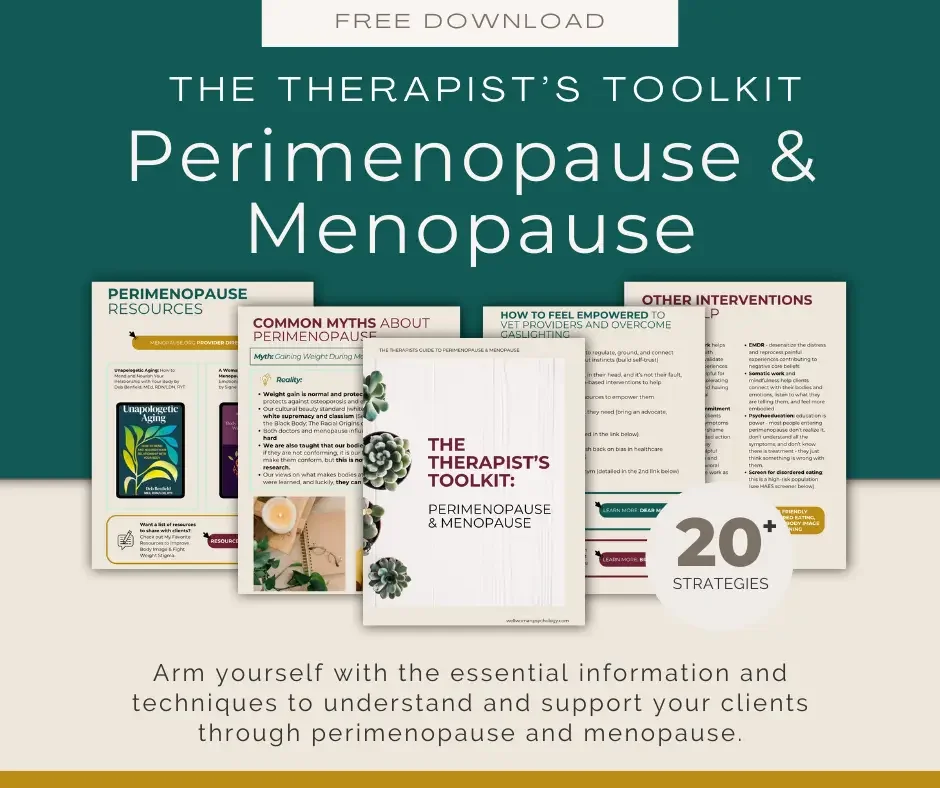
A free guide for therapists.
If you work in the mental health field, then check out this free toolkit I created to support clinicians in deepening their knowledge of perimenopause and menopause. Many clients feel dismissed by healthcare providers during this life transistion and that unfortunately also extends to therapists. Make sure you have the most up-to-date, bias-free information by grabbing this toolkit.
Start Online Therapy for Perimenopause in California:
You do not have to navigate this phase of life alone - Well Woman Psychology can help. Dr. Baggett is not only an expert on perimenopause with lived experience, but she offers compassionate, liberation focused, evidence-based therapy that can help you not only cope with all the physical and emotional changes, but let go of the pressures to be perfect that may have been chasing you until now. With the right support, this can be a time of powerful transition rather than just miserable symptoms. Get support now by following these steps:
Reach out for a consultation at Well Woman Psychology.
Meet with an online perimenopause therapist in California.
Start feeling more confident about moving through perimenopause.
About the Author:
Dr. Linda Baggett is a Licensed Psychologist and the founder of Well Woman Psychology. Serving clients virtually in California, Colorado, Illinois, New York, and Washington, Dr. Baggett has been focusing on women’s health her whole career, with experience working as a psychologist embedded in women’s primary care and OB/GYN clinics. In addition to her work on perimenopause, she helps clients to heal from trauma, relationship issues, sexuality, pregnancy loss and miscarriage, infertility, perinatal and postpartum struggles, and body image and size-based oppression. Additionally, she is trained in many evidence-based trauma treatments, including EMDR.
Disclaimer: This blog is for educational and informational purposes only, is not a substitute for individual medical or mental health advice, and does not constitute a client-therapist relationship.